


How to Calculate Your Zakat - Gold & Cash UK 2026
How To Calculate Your Zakat On Gold And Cash UK 2026
Every year, many Muslims intend to calculate their Zakat properly, but when Ramadan arrives, the calculation often becomes rushed. A figure is searched online, a few balances are checked, and the final amount is estimated rather than calculated carefully.
Zakat should not be based on guesswork. It is usually 2.5 percent of your qualifying wealth once your wealth reaches the nisab threshold and remains above it for one lunar year. If you live in the UK in 2026 and have bank accounts, ISAs, gold jewellery, savings, business income, or investments, you need clear numbers and a proper method.
When you are ready to calculate it properly, use a reliable tool like the AI Zakat calculator or read the full guide on how to calculate your Zakat correctly. A rough estimate may feel easier, but Zakat is an obligation and should be handled with care.
Understanding The Zakat Nisab Threshold In The UK For 2026
You only pay Zakat if your wealth reaches the nisab threshold. Nisab is the minimum amount of wealth that makes Zakat compulsory. If your qualifying wealth is below nisab, Zakat is not due. If it reaches or remains above nisab for one lunar year, Zakat becomes due.
The classical nisab weights are 87.48 grams of gold and 612.36 grams of silver. These weights do not change. What changes is their value in pounds, because gold and silver prices move daily.
To find the current nisab value in GBP, check trusted market data such as the London Bullion Market Association. Multiply the current price per gram by the relevant nisab weight. This gives you the 2026 UK nisab figure based on either gold or silver.
The next question is whether to use the gold nisab or silver nisab. The silver nisab is usually much lower in GBP, which means more people qualify to pay Zakat. The gold nisab is higher and is sometimes used by people with certain types of assets, depending on the scholarly opinion they follow.
The best approach is to follow the scholarly view you trust and remain consistent each year. Do not switch between gold and silver simply because one option feels cheaper in a particular year.
How To Calculate Your Zakat Gold And Cash UK 2026
The basic formula for calculating Zakat is simple. Add your total zakatable assets, subtract eligible immediate liabilities, and then apply 2.5 percent to the remaining amount.
Zakatable assets can include cash, gold, silver, business stock, money owed to you, and many types of investments. Immediate liabilities usually refer to debts and bills that are due now or in the short term, not the full amount of a long term mortgage.
When calculating your Zakat, review the following areas carefully:
- Cash in bank accounts
- Gold jewellery value
- Silver holdings
- Investment account balances
- Business stock sale value
- Money owed to you
- Short term debts due now
If your net amount is above nisab and one lunar year has passed, you pay 2.5 percent. The principle is straightforward, but it still requires accuracy, honesty, and proper record keeping.
Calculating Zakat On Cash Savings In UK Bank Accounts
Cash is usually the simplest part of the Zakat calculation. This includes money in current accounts, savings accounts, cash ISAs, and cash kept at home. If the money belongs to you and you can access it, it should be included.
On your Zakat date, check the balance of every account you own. Add the figures together, then subtract any immediate bills or short term debts that are genuinely due. If the remaining amount is above nisab, calculate 2.5 percent.
It is worth checking all accounts, even small savings accounts or older accounts you do not use often. Missing small balances can lead to an inaccurate calculation over time.
Zakat uses a snapshot method. Choose one Hijri date each year and calculate your assets on that date. Many people choose Ramadan for convenience and reward, but your actual Zakat date should be based on when your wealth first reached nisab and remained above it for one lunar year.
If you want your money to reach families directly without platform fees, read how 100 percent Zakat distribution works through direct cash transfers.
How To Calculate Zakat On Gold And Silver Jewellery In The UK
Gold and silver can be one of the most sensitive parts of the Zakat calculation because many people own wedding sets, gifts, inherited jewellery, or pieces kept for special occasions. These items can hold significant value and should not be ignored.
Many scholars say gold and silver jewellery is zakatable, even if it is worn. Some schools of thought have different rulings on jewellery worn for normal personal use, so you should follow the scholarly position you trust. If you are unsure, paying Zakat on the jewellery is often the safer option.
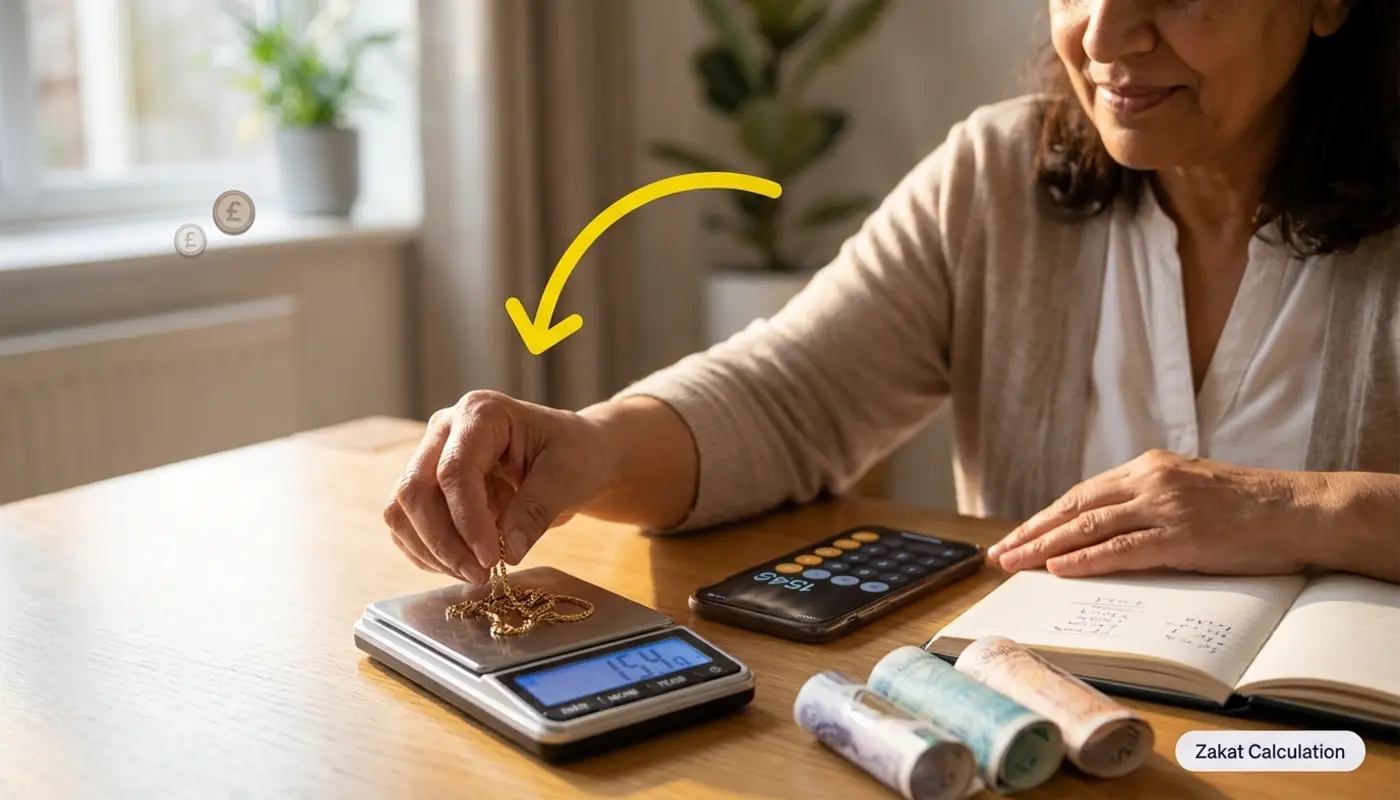
To calculate the value, weigh your gold in grams and multiply it by the current market price per gram. Do the same for silver. You should use the metal value, not the retail price, design value, or what the item cost when it was purchased.
For example, if you own 120 grams of gold and the market price is £60 per gram, the gold is worth £7,200. You would add this amount to your cash and other zakatable assets. If your total wealth is above nisab, you then apply 2.5 percent.
If you do not know the weight or carat of your jewellery, ask a trusted jeweller to weigh it and confirm the purity. Real numbers matter because Zakat is worship and should be treated seriously.
Zakat On ISAs Premium Bonds And UK Investments
Tax free does not mean Zakat free. ISAs, Premium Bonds, shares, and investment accounts should all be reviewed as part of your Zakat calculation.
Cash ISAs are treated like normal cash. The full balance is included in your zakatable assets on your Zakat date.
Stocks and Shares ISAs need a little more care. If you actively trade shares, many scholars treat them like trading stock, which means Zakat is calculated on the full market value on your Zakat date.
If you are a long term investor, some scholars allow you to calculate Zakat based on the zakatable portion of the company’s assets. This can be difficult for many everyday investors, so some UK Muslims choose to pay 2.5 percent on the full market value to keep the calculation simple and cautious.
Premium Bonds are generally treated like cash. Include the amount you hold in your calculation. You do not include possible future prizes, but any prize money already received and still owned on your Zakat date should be included.
For a clear step by step guide, read calculating your Zakat in detail.
Calculating Zakat On Business Assets And Self Employment Income
If you are self employed or run a business, it is important to understand that Zakat is not calculated on your yearly sales. It is based on your net zakatable position on your Zakat date.
You should include business cash, stock held for sale, and invoices that are likely to be paid. These are part of your business wealth and should be reviewed carefully.
You do not usually include fixed business assets such as your van, tools, machinery, office equipment, or furniture, because these are used to run the business and are not held for resale.
You can subtract short term business debts that are due now or soon. After that, apply 2.5 percent to the remaining zakatable amount.
Common mistakes include ignoring stock completely, underestimating invoices, or deducting long term loans in full. A careful calculation helps you avoid both underpaying and overcomplicating the process.
How The Lunar Hijri Calendar Affects Your Zakat Date
Zakat follows a lunar year of about 354 days. It does not follow the UK tax year, the financial year, or the January to December calendar.
When your wealth first goes above nisab, note the Hijri date. One lunar year later, your Zakat becomes due. After that, use the same Hijri date every year to calculate your Zakat.
Some people use the Gregorian calendar for convenience. If you do this, scholars often advise adjusting the rate to around 2.577 percent to account for the longer solar year. To keep things simple and closer to the original rule, many people prefer to use the lunar cycle and pay 2.5 percent.
Using Market Values For Accurate Zakat Calculation
Accurate Zakat calculation depends on using current values. Just as you would use statements for tax, accounts, or business reporting, you should use proper records for Zakat.
Your ISA statement should show the market value. Your investment app should show share prices. For shares and investments, use the value on your Zakat date. For gold, use clear UK market rates in GBP.
For business stock, use a realistic sale value or the method advised by the scholarly opinion you follow. Do not use inflated hopes or rough guesses. The aim is fairness, accuracy, and honesty.
Using UK Zakat Calculators Properly
There are many UK Zakat calculators online, and they can be useful. However, the calculator is only as accurate as the information you enter.
If you enter missing balances, wrong gold values, or incorrect debts, the result will also be wrong. Before using any calculator, gather your figures properly and understand which assets need to be included.
Once you have your numbers ready, a calculator can help organise the calculation and reduce mistakes. When you are ready to give, you can donate through Donate Directly, where funds go to verified families with zero platform fees.
Common Zakat Mistakes In The UK And How To Avoid Them
Many Zakat mistakes happen because people rush the calculation or rely on old information. One common mistake is using last year’s nisab figure even though gold and silver prices change regularly.
Another mistake is forgetting smaller savings accounts, cash ISAs, Premium Bonds, or money kept aside in separate pots. If it belongs to you and is zakatable, it should be included.
Some people also deduct their full mortgage or long term loans, which can distort the calculation. Usually, only short term amounts due now or soon are deducted.
Changing your Zakat date every year can also cause confusion. Your Zakat date should be based on your hawl, which is one full lunar year from when your wealth first reached nisab.
Rushing the calculation in the last ten nights of Ramadan can lead to errors. It is better to prepare your figures in advance, calculate carefully, and give with a clear intention.
If you want long term reward, consider options like Sadaqah Jariyah projects or direct support for orphan support. Calculate your Zakat carefully first, then give any additional charity with a separate intention.
Frequently Asked Questions
What Is The Nisab Threshold In 2026?
The nisab is based on 87.48 grams of gold or 612.36 grams of silver. Multiply these weights by current 2026 GBP prices to find your threshold.
How Is Zakat Calculated On Savings Accounts?
Add all cash balances on your Zakat date. Subtract immediate debts. If you are above nisab, pay 2.5 percent.
Do I Include My House And Car In Zakat?
No. Your main home and personal car are not zakatable unless they were bought for resale.
How Do Debts Affect My Zakat?
You can subtract short term debts due now. Do not usually subtract your full long term mortgage.
Can I Pay My Annual Zakat Monthly?
Yes. You can estimate your yearly Zakat and pay in instalments. Make sure the total paid matches what you owe on your Zakat date.
Zakat is not complicated, but it does need honesty, attention, and accurate figures. Calculate it properly, pay it correctly, and make sure it reaches people who truly need it.